 English
 Vietnamese

Market
 Kent C. Crouch
-
US House Committee Advances Strategic Bitcoin Reserve Bill After Clarity Act Setback
September 17, 2026 10:55:10
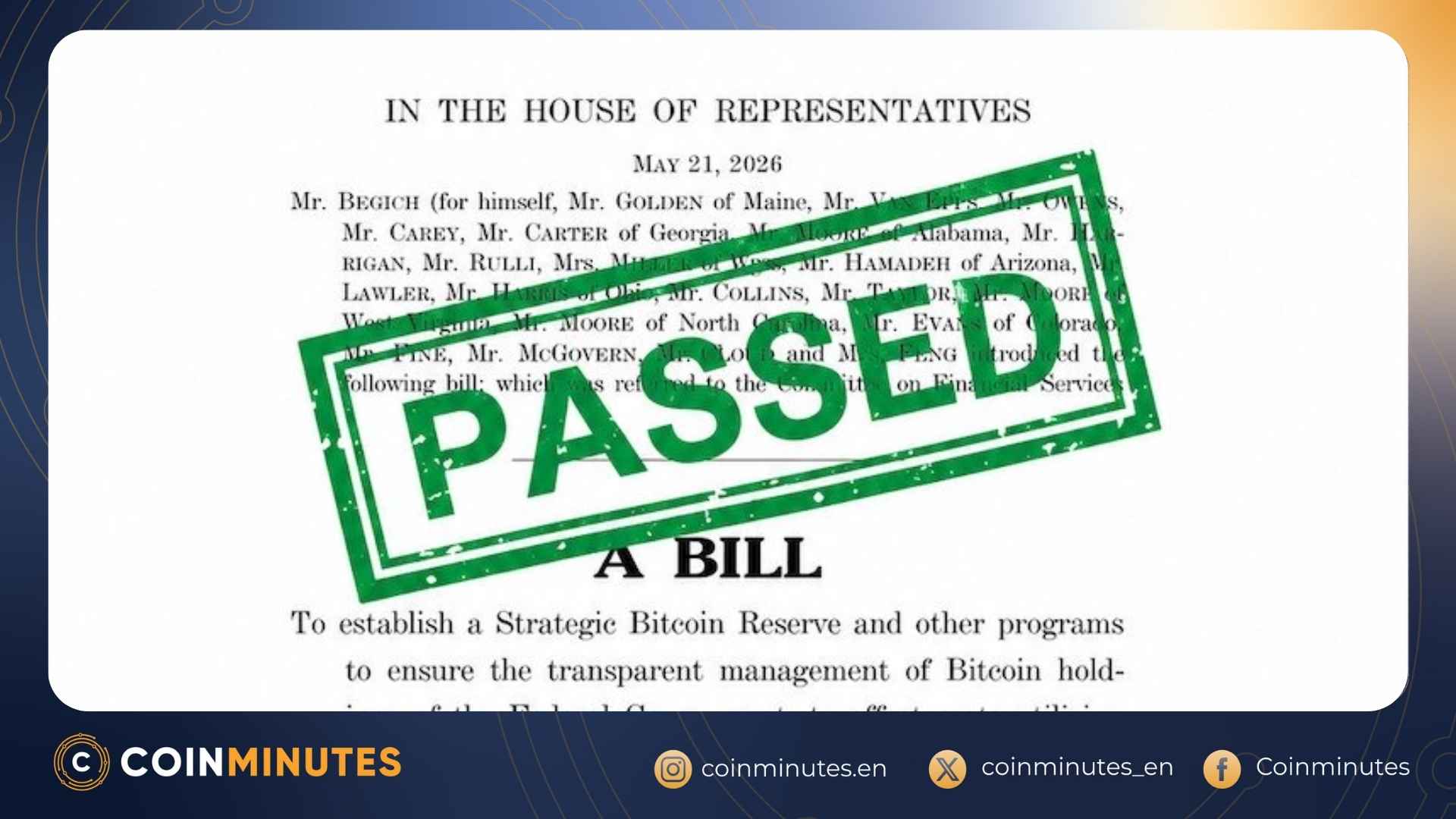
American Create a Strategic Bitcoin Reserve
The United States House Financial Services Committee voted on September 16 2026 to advance H.R. 8957, the American Reserve Modernization Act of 2026. The recorded vote was 28 to 21. The bill would place federally held Bitcoin into a Strategic Bitcoin Reserve managed by the Treasury Department and set long term rules for how those coins can be stored, reported, and used.
The measure is one of the most concrete legislative steps yet toward making Bitcoin a permanent part of the federal balance sheet. It would convert an existing presidential policy into statute rather than leave the reserve dependent on an executive order that a future administration could reverse.
What the American Reserve Modernization Act Would Do
The bill would consolidate Bitcoin acquired by the federal government through criminal and civil forfeiture into a single Treasury controlled reserve. Other digital assets seized by the government would sit in a separate Digital Asset Stockpile. The most important rule is a minimum 20 year holding period. Bitcoin placed in the reserve generally could not be sold, swapped, auctioned, or pledged during that time.
The legislation also requires quarterly public proof of reserve reports and independent third party audits. Supporters say this would give markets and taxpayers a clearer view of what the government actually holds. The bill further directs a study of budget neutral ways to add more Bitcoin over time and would allow states to store their own Bitcoin in segregated federal accounts. It also states that the government may not impair lawful private ownership or self custody of Bitcoin.
The bill does not require the Treasury to buy Bitcoin on the open market with new tax revenue. Its core function is to lock in coins the government already owns and to create a formal custody and disclosure system around them.
How Much Bitcoin the US Government Holds
On chain estimates put US government holdings near 324000 to 328000 Bitcoin. The coins came mainly from major forfeiture cases, including Silk Road related seizures, the Bitfinex hack recovery, and later enforcement actions. Those figures are market estimates based on wallet attribution, not an official audited disclosure. That gap in official reporting is one reason lawmakers added proof of reserve language to the bill.
President Donald Trump signed an executive order on March 6 2025 that directed agencies to retain forfeited Bitcoin instead of selling it at auction. The American Reserve Modernization Act is designed to write that policy into law and add custody, audit, and reporting standards around it.
Why the Timing Matters
The committee vote came one day after the Senate failed to advance the Clarity Act, a broader crypto market structure bill. That procedural vote fell short of the 60 votes needed to move forward. The contrast has shaped the political conversation. One major crypto bill stalled in the Senate while a narrower Bitcoin reserve bill moved through a House committee.
H.R. 8957 was introduced on May 21 2026 by Representative Nick Begich of Alaska and co led by Representative Jared Golden of Maine. Most original cosponsors are Republicans. Some Democrats on the committee raised concerns about Bitcoin volatility and whether a highly price sensitive asset belongs in a strategic reserve. An amendment offered by Representative Maxine Waters was rejected 21 to 28.
What Happens Next
Committee approval is not final passage. The bill still needs a vote on the House floor, then Senate consideration, then a presidential signature. No House floor vote has been scheduled. Even if the House passes the bill, the Senate remains a harder path after the Clarity Act defeat.
If enacted, the law would reduce the chance that a future president could quietly resume auctioning seized Bitcoin. It would also make government holdings harder to sell during market stress, which some investors see as a reduction in potential supply overhang. Critics argue that a 20 year lockup could leave taxpayers exposed to large paper losses if Bitcoin falls and that a volatile digital asset is a poor fit for official reserves.
Market and Policy Implications
The news is significant because it moves Bitcoin policy from campaign language and executive action into the regular legislative process. A statutory reserve would be harder to unwind than an executive order. At the same time, the bill is narrower than proposals that would force the government to buy hundreds of thousands of additional coins. Its immediate effect, if passed, would be legal permanence and disclosure, not a sudden wave of new purchases.
For readers following US crypto policy, the story is best understood as a split screen. Market structure legislation remains blocked in the Senate. Reserve legislation has cleared its first major House hurdle. Both tracks will now depend on votes in a Congress that has shown it can move one crypto bill and stop another in the same week.
The American Reserve Modernization Act is therefore not a finished policy. It is a committee stage bill with a defined custody model, a long holding period, and a live political fight still ahead.
-
Deutsche Bank Launches Institutional Crypto Custody Service in 2026
September 16, 2026 15:19:10
Deutsche Bank launches institutional crypto custody
Deutsche Bank has announced the launch of a crypto custody service for institutional clients, marking a significant step by one of Europe's largest banks into regulated digital asset services. The German lender, which holds approximately 1.7 trillion dollars in total assets, said institutional clients will be able to hold and transfer Bitcoin, Ether and selected stablecoins through the bank once remaining regulatory approvals are completed later in 2026.
The service will initially be available to clients in Germany. Deutsche Bank said it is targeting portfolio managers, hedge funds, custodians, brokers and asset funds, groups that already operate within the bank's existing compliance and operational framework. The bank also noted interest from corporate clients exploring blockchain technology and from a smaller number of digital asset firms.
Gerald Podobnik, co-head of Deutsche Bank's Corporate Bank, described digital assets as a complement rather than a replacement for the traditional financial system. He said the bank sees crypto as new rails that can coexist with existing market infrastructure while benefiting from the trust, security and investor protections that regulated financial institutions provide.
The announcement follows years of preparation. Deutsche Bank first outlined digital asset custody plans in 2022 and applied for a German custody license. In 2023 the bank invested in Swiss digital asset firm Taurus and partnered with it on custody and tokenization technology. In 2025 reports indicated Deutsche Bank would also work with Bitpanda Technology Solutions to help build the offering. The rollout comes as the European Union's Markets in Crypto Assets regulation has given banks clearer legal grounds to offer custody and related services.
Deutsche Bank said it plans to expand the range of supported assets over time and may include tokenized financial instruments. The move places the bank among a growing number of large European institutions that have begun offering or preparing institutional-grade crypto custody in 2026.
For institutional investors, bank custody reduces reliance on specialist crypto firms and allows digital assets to sit alongside traditional holdings under familiar banking relationships. The development is likely to be watched closely across Europe as more traditional banks integrate crypto into their core securities services.
-
Senate Fails to Advance Crypto Clarity Act in Key Procedural Vote
September 16, 2026 11:22:36

US Senate fails to advance the Crypto Clarity Act
The United States Senate on September 15 2026 rejected a motion to proceed on the Digital Asset Market Clarity Act also known as the Clarity Act or H.R. 3633. The vote ended 49 in favor and 50 against falling 11 votes short of the 60 vote threshold required to advance most legislation in the chamber. The outcome represents a significant setback for the cryptocurrency industry which had made passage of comprehensive market structure legislation its top policy priority in Washington.
The Clarity Act aims to create the first nationwide regulatory framework for digital assets in the United States. It would classify certain tokens whose value is tied to a decentralized blockchain as digital commodities under the primary jurisdiction of the Commodity Futures Trading Commission. Other assets more closely resembling investment contracts would remain under Securities and Exchange Commission oversight. The bill also sets registration requirements for exchanges brokers and dealers imposes anti money laundering rules and includes limited exemptions for token offerings on mature blockchains. A version of the legislation passed the House of Representatives in 2025 by a wide margin.
Senate Republicans released a revised draft of the bill shortly before the vote incorporating 126 changes requested during months of negotiations. Those changes included new ethics language and a role for state attorneys general in enforcement. Supporters argued the updates addressed concerns from Democrats and the banking sector particularly around stablecoin rewards that could compete with traditional bank deposits. The effort was not enough to secure bipartisan support.
All voting Democrats opposed the motion. Four Republican senators also voted no Susan Collins of Maine Josh Hawley of Missouri Jerry Moran of Kansas and Thom Tillis of North Carolina. Tillis later explained that his no vote was procedural so he could file a motion to reconsider and keep the option of bringing the measure back later. Senator Chris Coons of Delaware did not vote. No Democrat or independent supported advancing the bill.
The central point of disagreement was ethics provisions covering public officials crypto holdings. Democrats cited President Donald Trumps reported 1.4 billion dollars in crypto related income in 2025 from ventures including World Liberty Financial and a memecoin. They argued the bill did not require sufficient divestment or impose strong enough restrictions on family members and past proceeds. Several Democrats who had previously engaged in negotiations including Kirsten Gillibrand Mark Warner and Raphael Warnock ultimately voted against the measure. Republican opponents raised separate concerns about the impact on community banks.
Bitcoin declined about 1.3 percent in the hours after the vote falling below 76000 dollars. Shares of crypto related companies fell more sharply with Coinbase dropping more than 8 percent and Robinhood more than 3 percent. Industry groups that had spent more than 100 million dollars on advocacy expressed disappointment. Prediction markets lowered the odds of the bill becoming law in 2026 to roughly 6.5 percent.
Congress is scheduled to leave Washington for recess ahead of the November 2026 midterm elections. That timeline leaves little room for further negotiation in the current session. Some Republican aides have described the legislation as effectively stalled for now though the motion to reconsider filed by Senator Tillis technically keeps a narrow path open. In the absence of new statute the industry will continue to operate under existing guidance and enforcement actions from the SEC and CFTC.
The failed vote does not end debate over digital asset regulation. Both parties have acknowledged the need for clearer rules after years of uncertainty and high profile failures such as the collapse of FTX. Future progress will likely depend on the outcome of the midterms and whether lawmakers can resolve remaining differences over ethics standards and the treatment of stablecoins. Until then market participants face continued regulatory ambiguity in the United States.
-
CoinEx to Shut Down After Nine Years as Exchange Begins Orderly Wind Down
September 15, 2026 14:27:16
CoinEx is shutting down after nearly 9 years
CoinEx has announced that it will cease exchange operations and begin an orderly wind down after nearly nine years in the market. The notice was published on September 14, 2026 and takes effect from September 15, 2026. The Seychelles based platform said the decision followed a prolonged downturn in cryptocurrency markets, a sharp drop in industry trading volume and liquidity, and rising regulatory requirements and compliance costs across major jurisdictions.
The announcement has been widely reported after WatcherGuru and other market accounts shared the news on X. Reuters, The Block and several crypto publications later confirmed the details against CoinEx official notice titled Important Notice on CoinEx Orderly Cessation of Operations.
Why CoinEx Is Closing
CoinEx said management reached the decision after a prudent review of market conditions and operating risk. According to the exchange, overall industry activity has contracted significantly while the cost of meeting rules in major markets has moved beyond what the company considers a reasonable boundary.
Founder and chief executive Haipo Yang added a more personal explanation. He said CoinEx operated for nine years but did not become one of the leading exchanges in the industry. Yang wrote that security and compliance risks attached to running a centralized crypto exchange have become increasingly difficult to contain. Revenue can fall, he said, but responsibility does not. Carrying unlimited risk for limited revenue is no longer a rational choice.
Yang also said he seriously considered selling the platform and rejected that option. In his view, users entrusted assets to CoinEx based on trust in the platform and, in many cases, in him personally. Transferring that trust to a new owner was not the right way to end the journey. He said the goal is a clean ending in which users can withdraw in full and employees can leave with dignity.
Wind Down Timeline
The closure is staged rather than immediate. From September 15, 2026 CoinEx will stop new user registrations and stop paying referral rebates and campaign rewards. Futures markets will enter reduce only mode, meaning traders can close existing positions but cannot open or increase them. The platform will also stop accepting new subscriptions or orders for fiat services, margin trading, loans, Earn, staking and strategic trading.
On September 22, 2026 all non spot services will end. On chain deposits will stop except for CET deposits, which remain available until September 29. Remaining futures positions that are still open on September 22 are scheduled for forced settlement at the index price. Earn and staking products will be redeemed by the platform, and unpaid loans will be processed under existing liquidation rules.
On September 29, 2026 spot trading will stop and unfilled spot orders will be canceled. CoinEx Smart Chain and OneSwap will also cease operations. From 02:00 UTC on that date the platform will begin processing non USDT assets that have not been withdrawn in original form.
Withdrawal services remain open until 02:00 UTC on December 22, 2026. After that deadline the exchange says it will stop operating.
What Happens to User Assets
CoinEx stated that its asset reserve ratio exceeds 100 percent and that user balances are fully backed and available for withdrawal during the wind down window. The company pointed users to its published proof of reserves.
Users who want to withdraw assets in their original token form are told to complete those withdrawals before 02:00 UTC on September 29, 2026. After that time, assets with external market liquidity may be sold and converted into USDT, with net proceeds credited to spot accounts. Assets with little or no external liquidity may be delisted, and CoinEx said it will no longer take responsibility for custody or redemption of those tokens after the cutoff.
Any USDT that remains on the platform after December 22, 2026 will be moved into independent custody. CoinEx said a monthly custody fee of 5 percent of the original balance will apply. Users may later submit claims through support at coinex.com, and identity checks may be required. The claim window described in the notice runs until August 22, 2028.
CET Buyback and Related Products
CoinEx Token, or CET, will be repurchased at a fixed price of 0.005 USDT per CET. From September 15 to September 29 the platform said it will keep buy orders on the CET USDT pair at that price, with no quantity cap and with trading fees waived on that pair. From September 29 any CET still left in user accounts will be bought back automatically at the same price and converted into USDT. CoinEx said no further CET redemption channel will be offered after that.
CoinEx Wallet and CoinEx Vault are described as separate businesses and are not included in the exchange shutdown. ViaBTC, the mining pool associated with the same founder, has also said it operates independently and is not part of the exchange closure.
Security Warning
CoinEx called the September notice its final official announcement. The company warned that any later message issued in its name, including so called new rules or policy updates, should be treated as fraudulent. It said it will never ask for private keys, passwords or verification codes, and will never ask users to send funds to unlock accounts, claim compensation or receive airdrops.
Industry Context
CoinEx launched in December 2017 and grew as a mid sized global exchange linked to the ViaBTC group. Over the years it faced the same pressures seen across centralized venues, including tighter regulation in Europe under MiCA, periodic token delistings, and earlier operational shocks such as a 2023 security breach. Several other exchanges have also wound down in 2026, and CoinEx exit adds to a broader consolidation among platforms that can no longer justify the cost and liability of remaining open.
What Users Should Do
Anyone with balances on CoinEx should treat the calendar as firm. Withdraw as early as possible, allow extra time for network congestion and confirmation delays, and complete original asset withdrawals before the September 29 cutoff if that matters. CET holders can sell into the advertised 0.005 USDT buyback window or wait for the automatic conversion. Users should avoid new deposits and ignore unofficial messages that claim to speak for CoinEx after this notice.
-
Elon Musk đang tăng tốc tại Việt Nam?
September 14, 2026 13:52:54
-
Trezor Phishing Email After Brevo Breach What Hardware Wallet Users Need to Know
September 14, 2026 09:38:00
Trezor confirmed its third-party email provider was breached
A large phishing campaign targeted Trezor newsletter subscribers in September 2026 after attackers abused a security incident at Brevo, the third party email platform Trezor uses for marketing messages. The incident did not compromise Trezor devices, recovery seeds, or Trezor account systems. It did allow fraudulent mail to leave Trezor branded infrastructure and reach hundreds of thousands of inboxes.
What Happened
On September 9 2026, unauthorized access to Brevo accounts enabled attackers to send messages that appeared to come from Trezor. Trezor later confirmed that its opt in newsletter list of about 347000 addresses was used. The phishing subject line was Critical Security Alert STM32 Entropy Vulnerability. The message claimed that roughly one in four Trezor devices shipped with a factory STM32 random number generator defect and weak seeds of about 40 bits. Trezor stated that this claim is false. Entropy on Trezor devices comes from multiple sources, not a single STM32 generator.
Why the Email Looked Real
The messages were sent through Trezor mailing systems rather than a lookalike domain created from scratch. They passed common email authentication checks including SPF, DKIM, and DMARC. Links used Trezor tracking subdomains, which made the mail look official even to careful users who inspect the sender address. Trezor said it suspended the Brevo account, took the phishing domain down at the DNS level within about twenty minutes, and contacted subscribers. About 2500 people clicked the link before it stopped working.
What Attackers Wanted
Reported variants asked users to check whether a device was affected, verify an xPub, download an app, or enter a wallet backup. An xPub cannot spend funds by itself, but it reveals addresses and balances and can feed later targeting. A recovery phrase can recreate a wallet and move funds with no reversal. Trezor warned users never to enter a seed, PIN, or xPub on a website after receiving this kind of alert.
Related Exposure
The campaign followed an earlier ShipMonk shipping partner leak that exposed names, emails, phones, and home addresses for tens of thousands of Trezor customers. Devices and seeds were not taken in that leak. Combined with newsletter addresses from the Brevo incident, contact data can support more phishing. Similar abuse of Brevo access was also reported around BitBox and CoinTracking newsletter lists.
How Users Should Respond
Ignore any email that mentions an STM32 entropy bug or asks for wallet verification outside official Trezor Suite or the official website. Confirm alerts only through Trezor official channels. Do not click links in unexpected security mail even when the sender looks correct. Hardware wallets remain useful because private keys stay offline, but email and shipping vendors remain a common weak point. Treat all 347000 newsletter addresses as potentially known to attackers and expect follow up scams.
Official Confirmation and Scope
Trezor published that no other Trezor system was touched and that only newsletter emails sat in the Brevo account. Brevo later described a login authorization problem that let an attacker reach many customer accounts across its platform. Trezor added warnings on its site, Suite, and social channels. The core product claim stands: this was phishing after a vendor breach, not a factory defect in Trezor hardware.
Searchers looking for Trezor phishing email, Brevo breach, or STM32 entropy vulnerability should rely on Trezor official statements. The practical rule is simple. Never share a seed or xPub because an email looks urgent and authentic. Verify first, then act only inside software you already trust.
-
Symbiosis Recovers 15 BTC After Bitcoin Bridge Exploit as Final Losses Remain Under Review
September 14, 2026 09:32:00

Symbiosis exploited on BSC
Cross chain liquidity protocol Symbiosis confirmed a security incident on its native Bitcoin Bridge that began around 04 28 UTC on September 11 2026. On chain security firm Blockaid first flagged the activity publicly. An attacker used a vulnerability in the BridgeV2 system to mint a very large quantity of unbacked syBTC on BNB Smart Chain. The tokens carried a notional face value of about 46.1 billion dollars when counted at eight decimals. Actual realized proceeds were far smaller. The same beneficiary sold roughly 4.39 WBTC on Ethereum Uniswap V4 and extracted about 336000 dollars.
Symbiosis said only the Bitcoin Bridge was hit and that it isolated the component from the rest of its stack. Routes across EVM chains TRON and TON continued operating along with Octopools and other products. The protocol halted native BTC routing while its relayer group kept running. Bitcoin swaps later returned through partner venues Chainflip and THORChain. The native Symbiosis Bitcoin Bridge remained paused as of September 13 with no public restart date.
The team reported recovering approximately 15 BTC and moving those coins into a team controlled multisig wallet. It offered the attacker a white hat bounty of 20 percent of returned funds with a window through September 13 2026. After that date the same 20 percent would apply to anyone who provided information that led to further recovery. Final accounting was still underway and confirmed loss figures had not been published. Symbiosis said it was contacting affected liquidity providers directly and preparing a compensation framework.
The case sits alongside other recent incidents in which bitcoin wrapper or bridge systems minted tokens without matching reserves including events tied to Liquid Network and Nomic. Blockaid detection shortened the window for additional extraction. Users with exposure to the paused native BTC route should wait for official accounting and compensation criteria rather than assuming the 336000 dollar cash out figure is the complete loss. The protocol said it would publish further updates as numbers and LP terms are finalized.
-
Revolut Discloses Customer Passports and Bitcoin Records After Fake Government Request
September 14, 2026 09:27:54

Revolut handed over customer after a fake government request
Revolut confirmed that it released sensitive customer information after responding to a fraudulent request that appeared to come from a legitimate government agency. The incident became public in mid September 2026 after affected customers received official notices and researchers shared details of what had been disclosed.
The request did not come from a lookalike address. It was sent from an unauthorized mailbox on a genuine government domain and carried valid authentication credentials. Because the message passed standard email checks, Revolut processed it as a lawful information demand and handed over customer records. The company later contacted the agency through a separate channel and concluded that the request was not authentic.
This was not a hack of Revolut systems. The company has said that its platforms were not breached and that customer funds, login details, card numbers and cryptocurrency private keys were not compromised. The damage came from a process failure. A request that looked legally valid was treated as genuine and fulfilled.
According to the notices sent to customers, the disclosed information may have included full names, dates of birth, occupations, home addresses, email addresses and phone numbers. It may also have included copies of passports or driving licences, facial verification selfies provided during account onboarding, account statements, IBAN details, account status, opening dates, wallet reference numbers, withdrawal records and complete transaction histories, including Bitcoin activity. Revolut said biometric facial telemetry data was not shared.
The company described the number of affected customers as limited but has not published an exact figure. It has also declined to name the government agency whose domain was used or say whether the incident was confined to a specific market. On chain investigator ZachXBT said the case appeared limited in scale and may have targeted higher net worth users. Former Mt Gox chief Mark Karpeles said he received one of the customer notices.
Revolut said it blocked the email address after identifying the problem, alerted the relevant government agency, notified law enforcement, data protection authorities and financial regulators, and applied extra protections to affected accounts. Customers were informed from 11 September 2026. The company has not issued a detailed public statement on its main channels and has provided most of its official comments through spokespeople speaking to news outlets.
The case has drawn attention because it combines identity documents with financial and crypto records. A passport image, a verification selfie, a home address and a full Bitcoin transaction history create a much richer package than a typical email and password leak. For users who buy, sell or withdraw crypto through Revolut, that combination can link a real world identity to on chain activity.
The episode also raises questions about how financial firms verify legal requests. Banks and fintech companies routinely respond to information demands from police, regulators and tax authorities. Those requests are often treated as high priority and are not expected to look like ordinary phishing. When an email arrives from an official domain and passes technical authentication, internal teams may have little reason to challenge it. That is the gap this incident appears to have exploited.
Revolut has told customers that their accounts and assets remain secure. Affected users have been advised to treat unexpected messages with caution and to verify any request through official in app support rather than by email. The company has not said how the unauthorized mailbox was created on the government domain, when the request arrived, or whether the disclosed data has already been used.
As of mid September 2026, the full scope of the incident remains unclear. What is clear is that Revolut did not lose control of its systems. It handed over highly sensitive records because a request from a real government domain looked authentic. For a company that collects passports, selfies and detailed transaction histories as part of compliance, that distinction matters less to the customers whose files were sent out.
-
Why PONS Token Price Surged on Robinhood Chain?
September 4, 2026 10:59:25

PONS increased by over 500% in 7 days
The PONS token has drawn heavy attention after a sharp rally that lifted its price by more than 500 percent in seven days and pushed its market capitalization toward the 500 million dollar range. The move looks dramatic on a chart, but the story behind it is more specific than a typical meme coin pump. PONS is the native token of Pons, the leading permissionless token launchpad on Robinhood Chain, the Ethereum layer 2 network that Robinhood brought to public mainnet in July 2026.
Pons lets anyone deploy a fixed supply token and start trading from a connected wallet without the platform taking custody of funds. The product sits at the center of a busy new chain that supports both meme tokens and tokenized stocks. As launch activity concentrated on Pons, trading fees and protocol revenue scaled quickly. That activity is the main reason the market began to reprice PONS.
How the PONS token is tied to platform fees?
The tokenomics are straightforward and easy for traders to follow. Trades on Pons typically carry a 1 percent fee. About 70 percent of that fee goes to the token creator and 30 percent goes to the protocol. Pons routes most of the protocol share, reported at around 80 percent, into automated buybacks of PONS. Purchased tokens are sent to a burn address and removed from circulation.
On chain data and project updates put the burned supply near 29 percent of the original 1 billion token cap, leaving a circulating supply around 712 million. The design creates a simple loop. More launches produce more volume. More volume produces more fees. More fees produce more buybacks and burns. Shrinking supply plus constant buy pressure is the core reason many traders treat PONS as a platform token rather than a standalone meme.
What changed in early September 2026?
Several catalysts arrived in a short window. Pons recorded extremely high fee days, at one point generating close to 6 million dollars in fees over 24 hours and capturing a large share of launchpad volume on Robinhood Chain. Creators on the platform have collectively earned tens of millions of dollars in fees paid in ETH, USDG, or supported stock tokens.
Distribution also improved. PONS was added to Binance Alpha, which brought new liquidity and a wider set of traders. Around the same time, Pons said Uniswap Labs purchased PONS for long term alignment. The size of that purchase was not disclosed, but the announcement mattered because Pons V2 graduates tokens into Uniswap v4 pools and Robinhood Chain has become a major venue for Uniswap v4 volume.
Together, those events changed the narrative from an obscure launchpad token to a liquid asset linked to one of the busiest new onchain markets of 2026.
Why the growth is not only hype?
The rally is easier to explain when platform usage and token mechanics are viewed together. Robinhood Chain grew fast because fees are low and the network can host both speculative tokens and tokenized equities. Pons became the default launch venue for a large share of that activity. Unlike many launchpad tokens that depend on promises, PONS receives a mechanical bid whenever the protocol earns fees.
That does not make the token low risk. The price is still driven by speculative flows, perpetual futures, and short term momentum. Daily volume has often exceeded 100 million dollars, which supports liquidity but also increases volatility. If launch volume on Robinhood Chain cools, protocol fees will fall and the buyback engine will slow.
Competition is another constraint. Uniswap Labs launched its own Robinhood Chain launchpad, Pools.trade, with a lower fee model. Pons has so far kept the lead in fees and market share, but that lead is not guaranteed. Any durable valuation for PONS depends on whether the platform continues to win launches after the first wave of attention fades.
What to watch next?
The useful questions are operational, not promotional. Can Pons hold a high share of Robinhood Chain launch volume. Do protocol fees stay large enough to fund meaningful buybacks. Does circulating supply keep falling through burns. And can the token hold liquidity on both decentralized pools and centralized venues after the first listing spike.
PONS rose because a new chain produced a burst of token launches, one launchpad captured most of that flow, and a large share of protocol fees was programmed to buy and burn the native token. That is a clearer thesis than most short term crypto rallies. It is also a thesis that can reverse quickly if activity on Robinhood Chain slows. Anyone following the story should treat the price action as a function of platform revenue, not as proof that the move will continue.
-
Strategy Resumes Bitcoin Buying With 4603 BTC Purchase After Two Month Pause
September 3, 2026 14:00:16

Strategy is buying Bitcoin again after a 10-week pause
Strategy Inc, the Nasdaq listed company formerly known as MicroStrategy, has returned to Bitcoin accumulation after more than two months without a confirmed purchase. In a Form 8-K filed with the U.S. Securities and Exchange Commission on August 31, 2026, the firm said it bought 4,603 Bitcoin between August 24 and August 30 for 369.7 million dollars. The average purchase price, including fees and expenses, was 80,318 dollars per coin.
The latest transaction lifted Strategy Bitcoin holdings to 845,050 BTC as of August 30, 2026. The company reported an aggregate purchase price of 63.73 billion dollars and a blended average cost of 75,412 dollars per Bitcoin. That position remains the largest corporate Bitcoin treasury among publicly listed companies and is equal to about 4 percent of the 21 million coins that will ever exist.
Strategy financed the buy through its at the market offering of Class A common stock. During the same week the company sold 4,531,421 MSTR shares and raised 602.8 million dollars in net proceeds. Of that amount, 369.7 million dollars went to Bitcoin, 151.8 million dollars funded repurchases of STRC preferred stock, 50.7 million dollars covered STRC dividends, and 30 million dollars was added to the firm’s USD Cash account. As of August 30, Strategy reported a USD Reserve of 5.10 billion dollars and USD Cash of 1.61 billion dollars, for combined dollar liquidity of about 6.71 billion dollars. Management also said net leverage stood at zero.
The purchase is notable because it ended a long pause. Strategy last disclosed a Bitcoin acquisition on June 22, 2026, when it added 520 BTC. After that, the company shifted toward balance sheet management. Earlier in the summer it sold Bitcoin under a monetization program used to support preferred stock dividends and STRC buybacks. Those sales reduced the stack from a mid June peak of 847,363 BTC. By early August holdings had fallen to 840,447 BTC before the latest buy lifted the total again.
Executive Chairman Michael Saylor had already signaled a change in tone shortly before the filing, telling followers that the company was back. The message mattered to investors because Strategy had spent years building its identity as a permanent Bitcoin buyer. The 2026 pause and limited sales created doubt about whether that playbook still applied. The August purchase does not erase those earlier sales, but it does show that the firm is willing to issue common equity again and add to the reserve when it sees an opening.
The new coins were bought above Strategy’s long run average cost. At the time of the disclosure Bitcoin was trading closer to the high 70,000 dollar range, and by early September the market was still near that area. That means the latest lot was added at a premium to both the company’s blended cost basis and to subsequent spot prices. The overall treasury, however, still sat above its cumulative purchase price when valued against late August and early September levels.
For the market, the filing is less about the size of one weekly order and more about what it says about Strategy’s operating model. The company is no longer only a one way accumulator. It now runs a Bitcoin reserve alongside a large dollar reserve, preferred stock obligations, and a stock issuance program that can fund several uses at once. Buying 4,603 BTC after a two month gap suggests accumulation remains central, but it now sits inside a broader capital framework rather than as the only weekly priority.
Strategy Bitcoin holdings will continue to be watched because the firm is still the dominant public proxy for corporate Bitcoin exposure. Each weekly 8-K can move sentiment around MSTR and around institutional demand more broadly. This latest update shows a return to buying, a still massive treasury, and a balance sheet that management presents as fully funded and unlevered on a net basis. Whether the company keeps adding at a similar pace will depend on equity issuance conditions, preferred stock markets, and Bitcoin’s next move.


Crypto Market Analysis: Early 2026 – Narrative Flows and Investment Opportunities
 Richard Espinoza
January 30, 2026
Richard Espinoza
January 30, 2026
Frequently asked questions
CoinMinutes' Market category is your first choice for crypto market news, trends, insights, and analysis from all over the world. We report on fresh market changes as they occur, follow both short and long-term trends of both main and new assets. We also offer detailed analysis for readers to understand what is behind the change of price from big economic changes and institutional actions to on-chain data and sentiment indicators.
If huge market changes occur, such as a major coin being listed on an exchange, a large-scale liquidation event, or an unexpected macroeconomic announcement, CoinMinutes will provide you with fast, factually correct news that includes well-explained background information. Our team goes beyond simply reporting what happened; they explain why it is important for the overall market, so that readers will be one step ahead of the developments by knowing the reasons rather than just the results.
CoinMinutes keeps a close eye on a vast array of market trends, starting with Bitcoin. Ethereum price cycles are influenced by the rise and fall of narratives such as DeFi, AI tokens, Layer 2 solutions, and memecoins. Our coverage of trends examines changes in market sentiment over a short period as well as those changes that shape the market over time. This is done by analyzing on-chain metrics, trading volume patterns, and macroeconomic context to provide readers with a comprehensive view of where the market is headed.
While basic price reporting only tells you whether the price of an asset has gone up or down, analysis content in the Market category of CoinMinutes goes further into the reasons behind the behavior of the market. It covers technical analysis of important price levels, fundamental evaluation of project developments, and a macro-level view linking the crypto markets to the overall financial world. Every analysis article is clearly marked and designed to give readers an understanding that they can use actively, not just the bare data.
Yes, certainly. CoinMinutes' Market section is designed to cater to individuals with varying degrees of experience. Market news is communicated in a simple, clear way so that newbies will not be lost, while at the same time, our trend and analysis pieces contain the layers and subtleties that seasoned investors require. No matter if you are exploring your first market cycle or seeking comprehensive insights to develop a trading strategy, the Market section is capable of providing you with valuable resources.
-
 News
News
-
Market
-
Learn
-
Reviews
Popular Posts
Tokenization: How Assets Become Investable On-Chain
 Ashley Carter
August 17, 2026
Ashley Carter
August 17, 2026
XRP: How It Powers Cross-Border Payments
 Emily Johnson
July 25, 2026
Emily Johnson
July 25, 2026
 Samantha Jordan